Exhibitions
Coming in 2015.
Coming in 2015.
"From space, the planet is blue. From space the planet is the territory not of humans but of the whale"
Heathcote Williams (born 15 November 1941) is an English poet, actor and award-winning playwright. He is also an intermittent painter, sculptor and long-time conjuror. He is perhaps best known for the book-length polemical poem Whale Nation, which in 1988 became "the most powerful argument for the newly instigated worldwide ban on whaling."
"Whale Nation" described as and "epic plea for the future of the whale, a hymn to the beauty, majesty and intelligence of the largest mammals on earth, as well as a prayer for their protection... Whale Nation became the most powerful argument for the newly instigated worldwide ban on whaling, and for a moment, back in 1988, it seemed as if a shameful chapter in human history might finally be drawing to a close."
Poet Maureen Duffy celebrates the incredible impact of Heathcote Williams’ epic poem, which inspired an international campaign.
http://www.resurgence.org/magazine/article3626-whale-nation.html
Poetry and Emotion in Ocean and Motion
For an audio sample of this poetry master piece:

Act 3, Scene 2, Page 17
Hamlet: Do you see yonder cloud that's almost in shape of a camel?
Polonius: By th' Mass, and 'tis like a camel, indeed.
Hamlet: Methinks it is like a weasel.
Polonius: It is backed like a weasel.
Hamlet: Or like a whale.
Polonius: Very like a whale.

In 1577, at age 63, Adriaen Coenensz from Scheveningen ( 1514 - 1587 ) a Dutch fish merchant and auctioneer of sea fish and also amateur ichthyologis started working on his Fish Book.
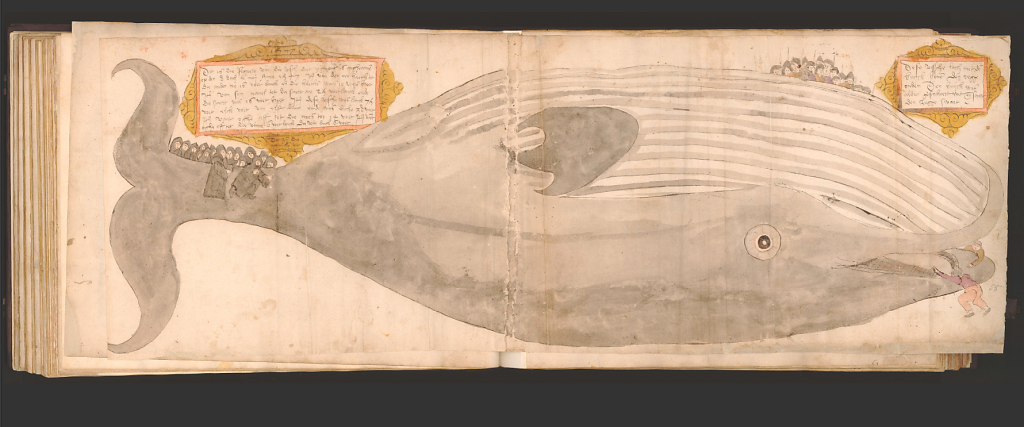
In three years, he gathered all information he could find on the sea and its coasts, coastal waters, fishing grounds and marine animals. He described them expertly in more than 800 pages. Coenensz got his information from his own practise: he was a Scheveningen fisherman and auctioneer and, later on, wreck master of Holland, so that every strange creature that washed ashore was brought to him for inspection. His reputation as expert on marine matters grew thanks to the connections he made as a self-educated man with academics at The Hague and Leiden, who gave him learned works on the sea on loan.
Coenensz copied extracts from them into his Fish Book. Coenensz turned almost every page into a separate work of art by painting borders and frames around the watercolour illustrations he added to the texts.
He must have realised the special character of his book; in the Leiden Court of Law's journal for 1583 a note is found saying that Coenensz has applied for permission 'to show his book and his collection of dried fish specimens at the approaching fair and the feast of the relief of Leiden (3 October), receiving from each person a penny, and from those who want to see the book a farthing'.
Coenensz turned his knowledge into profit.
On the basis of this manuscript, Coenensz produced another book a couple of years later. This book, the Whale Book, is now kept at Antwerp. A third manuscript, also with drawings of whales, is preserved in Cologne.

After spending nearly 10 years developing and designing web applications for universities and research projects worldwide, I am finally going back to my original interests.
The Whale Nation Project started as a 100% self-funded venture where I was going be be documenting as many cetacean strandings as possible. The aim was to produce enough of a body of work for an exhibition where a combination of still and moving images will be shown. Although the genesis of the work was based on a conceptual idea, the final output will have a strong educational-driven outlook.
The production leg of the project officially started on Boxing Day 2011 when a huge 55 feet long Bull Sperm Whale stranded on a North Norfolk beach. Since then the idea has grown and I am also going to be working with underwater equipment to film and photograph live whales in their natural element.
On the Summer of 2014 I will be spending some time in some South Pacific islands to document the migration of the Humpback whales form the cold food-rich waters of the Antarctic Ocean to the warm sallow waters of the Kingdom of Tonga.
I am currently seeking any private or public funding to take this idea further, both geographically and conceptually. Further funding will be used to pay for traveling expenses as well as an assistant much needed while taking footage of whales.
Javier Delgado Esteban To learn more about strandings, The UK Cetacean Strandings Investigation Programme is a good source: http://ukstrandings.org/
Natural History Museum's UK whale and dolphins strandings page: http://www.nhm.ac.uk/nature-online/life/mammals/science-whalestrandings/
"From space, the planet is blue. From space the planet is the territory not of humans but of the whale" “Whale Nation”. Heathcote Williams. 1988
.........................................................................................................................................................................
Después de pasar casi 10 años desarrollando y diseñando aplicaciones web para universidades y proyectos de investigación medioambientales en todo el mundo, al fin voy a regresar de nuevo a mis intereses originales.
El Proyecto "Whale Nation" comenzó como un documental 100% autofinanciado acerca de varamientos de cetáceos.
El objetivo era producir suficiente cantidad material para una exposición para mostrar una combinación de fotografía y video.
Aunque la génesis de la obra se basa en una idea conceptual, el resultado final tendrá una fuerte perspectiva educativa.
El proyecto se inició oficialmente el Día de San Esteban de 2011, cuando un enorme cachalote de 55 28 metros de largo quedo varado en una playa del norte de Norfolk.
Desde entonces, la idea ha crecido y estoy también trabajando con equipos subacuáticos, para filmar y fotografiar ballenas vivas en su elemento natural.
En el verano de 2014 Pasaré algún tiempo en las islas del Pacífico Sur para documentar la migración de las ballenas jorobadas desde las aguas ricas en alimentos frías del Océano Antártico a las cálidas aguas poco profundas del Reino de Tonga.
Actualmente estoy buscando ninguna financiación privada o pública para llevar esta idea más lejos, tanto geográfica como conceptualmente. La financiación adicional se utilizará para pagar los gastos de viaje, así como un asistente muy necesario particularmente mientras filmamos bajo el agua.
Javier Delgado Esteban
Para aprender más sobre varamientos, El Programa de Investigación de Cetáceos Varamientos Reino Unido es una buena fuente: http://ukstrandings.org/
O en la pagina del Museo de Historia Natural: http://www.nhm.ac.uk/nature-online/life/mammals/science-whalestrandings/
"Desde el espacio, el planeta es azul. Desde el espacio la tierra no es el territorio no de los humanos, sino de la ballena" Whale Nation. Heathcote Williams. 1988